
Empowering Young Minds from Grade 3 to Grade 11
“Teaching children how money works today, so they can build the world of tomorrow.”
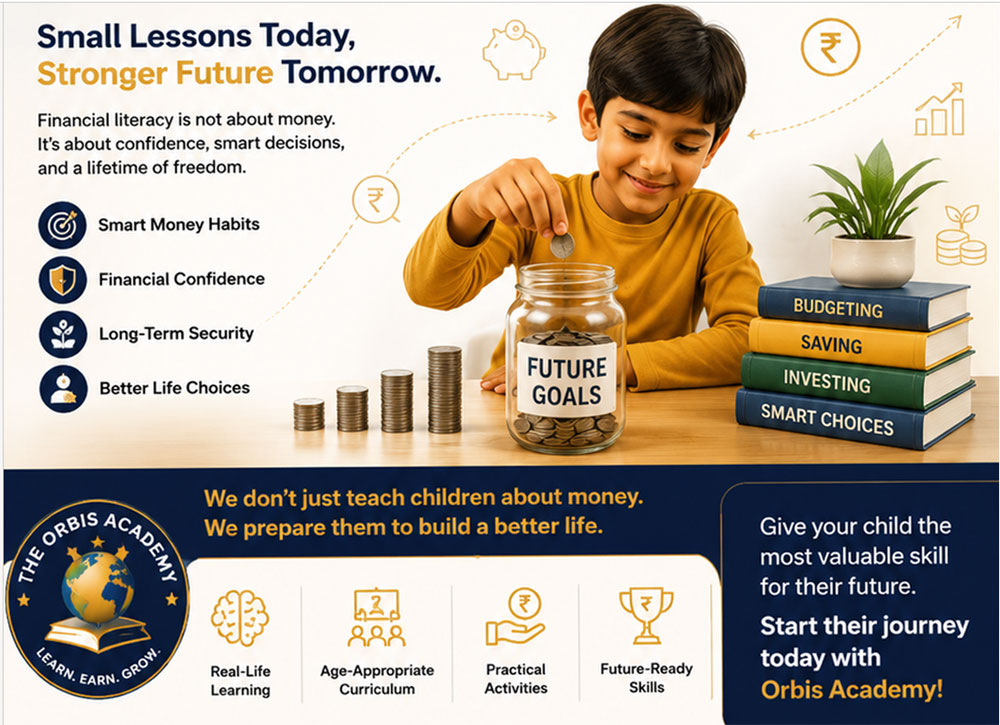
WHY DOES YOUR CHILD NEED FINANCIAL LITERACY?
Most schools teach maths, science, and languages — but almost none teach children how money actually works. By the time a young person earns their first salary, they often have no idea how to budget, save, invest, or avoid debt. At The Orbis Academy, we change that — starting from Grade 1.
Comparison Table
| Without Financial Literacy | With Orbis Academy |
|---|---|
| Child doesn't understand where money comes from | Learns earning, value of work, and income from Grade 3 |
| Spends everything, saves nothing | Builds saving habits using the 50-30-20 rule by Grade 4 |
| No idea what a budget is | Creates real monthly budgets and tracks spending by Grade 6 |
| Never heard of investing or compound interest | Understands stocks, mutual funds, and compound growth by Grade 9 |
| Vulnerable to debt traps and scams | Learns about credit scores, interest rates, and fraud by Grade 11 |

OUR CURRICULUM — GRADE 3 TO GRADE 5
Building the Foundation
In the early grades, we focuson understandingmoney,needsvswants, and the habit of saving. Everything is taught through stories, games, and real-life activities that children love.
Grade 3 – 4 | Ages 8–10
- What is money? Coins, notes, and their value
- Needs vs Wants — “Do I need it or do I want it?”
- Where does money come from? Parents go to work to earn money
- My Piggy Bank — the basics of saving
- Giving & Sharing — why we donate and help others
Example: Students play “The Market Game” — they get 10 coins and must decide what to buy from a
classroom shop. They quickly learn they cannot buy everything!
Grade 5 – 6 | Ages 10–11
- Making a simple budget — pocket money planning
- Introduction to banks — what is a savings account?
- The difference between earning, spending, and saving
- Smart Shopping — comparing prices and finding value
- Goal Setting — saving up for something you really want
Example: Students receive a “Monthly Pocket Money Card” with $50 in play money. They must pay for school supplies, snacks, and fun — and track every rupee spent in a notebook.
Grade 7 | Ages 12–13
- Introduction to entrepreneurship — selling something you make
- Simple profit and loss — if I buy for $5 and sell for $8, I earn $3
- Taxes explained simply — why governments collect money
- Digital money — what is an online payment or UPI?
- Good habits vs bad habits with money
Example: Students run a “Mini Business Day” — they make greeting cards, bookmarks, or simple crafts and sell them to classmates. They calculate their profit and donate 10% to a class charity
OUR CURRICULUM — GRADE 8 TO GRADE 9
Building Practical Money Skills
In middle school, students move from basic concepts to real-world application. They learn to budget like adults, understand banking properly, and begin exploring the world of investing — in simple, age-appropriate ways.
Grade 8 | Ages 13–14
- Creating a real monthly budget using the 50-30-20 Rule
- 50% Needs, 30% Wants, 20% Savings — applied to real life
- Understanding bills and household expenses
- Introduction to inflation — why things cost more each year
- Making smart choices at the supermarket
Example: Students receive a simulated “Family Income of $2,000/month” and must pay rent, electricity, groceries, transport, and still save 20%. They present their budget to the class.
Grade 9 | Ages 14–15
- How banks make money — interest rates explained
- Fixed Deposits vs Savings Accounts — which is better?
- Credit cards — how they work and why they can be dangerous
- What is a loan? EMIs and how interest adds up
- Introduction to insurance — protecting what you have
Example: Students use a “Compound Interest Calculator” activity. They see that $1,000 saved at age 13 becomes over $7,000 by age 40 — without adding a single rupee more. This always surprises them!
Grade 10 | Ages 15–16
- What is the stock market? Buying a “piece” of a company
- Bulls and Bears — market going up and down
- Mutual Funds — investing together as a group
- Reading a simple company balance sheet
- Risk vs Return — why higher returns mean higher risk
Example: Students participate in a 4-week “Virtual Stock Market Game.” Each student gets $10,000 in virtual money to invest in 5 real companies. They track their portfolio weekly and present their gains/losses at the end.
OUR CURRICULUM — GRADE 10 TO GRADE 11
Advanced Financial Thinking
By high school, students are ready for advanced topics—the same knowledge that most adults never learn. They’ll graduate not just understanding money, but knowing how to grow it, protect it, and use it to build freedom.
Grade 10 | Ages 15-16
- Reading and understanding a payslip — gross vs net salary
- Income Tax basics — what is TDS, and why is it deducted?
- Building an emergency fund — 3-6 months of expenses
- Introduction to Real Estate — renting vs buying a home
- Cryptocurrency basics — what it is, and why it’s risky
Example: Students receive a mock payslip showing gross salary, tax deductions, PF contributions, and net take-home. They calculate what percentage of salary goes to tax and what’s left to live on.
Grade 11 | Ages 16–17
- What is a Credit Score and how is it calculated?
- How to build good credit from a young age
- Understanding SIP — Systematic Investment Plans
- Financial Goal Planning — short, medium, and long-term goals
- Avoiding common money scams and Ponzi schemes
Example: Students build their own “10-Year Financial Roadmap” — from getting their first job at 22, to buying a car at 25, investing for retirement at 30. They present it using a simple chart and timeline.
Some Advance Concepts we cover
- Starting a business — business plans, funding, and cash flow
- Understanding IPOs, bonds, and different asset classes
- Global economics — exchange rates and global trade basics
- Personal Finance Audit — reviewing your own financial health
- Capstone Project: Build your personal Financial Independence Plan
Example: In the final capstone project, Grade 11 students present a complete “Personal Financial Plan” covering income goals, investment strategy, insurance needs, and a 20-year wealth projection — just like real financial advisors do.
HOW WE TEACH AT ORBIS ACADEMY
Games & Simulations
Frommarketgames in Grade 3 to virtual stock
markets in Grade 8 — we make money fun and
real.
Workbooks & Projects
Everystudent getsage-appropriate workbooks
with activities, budgeting sheets, and goal
trackers.
Guest Speakers
Real entrepreneurs,bankers, and investors
talk to students — giving them real-world
perspective.
Competitions
Inter-schoolfinance quiz competitions,
business plan challenges, and investment
tournaments
Digital Tools
tudents learntouse budgeting apps,
investment simulators, and spreadsheets from
Grade 6 onwards.
Monthlyparentnewsletters and family activities
solearningcontinuesathome too.
WHAT YOUR CHILD WILL ACHIEVE
- Understand how money works — earning, spending, saving, investing
- Build life-long habits of budgeting and financial discipline
- Know how to set financial goals and achieve them step by step
- Be confident about banking, loans, credit, and investments
- Understand taxes, insurance, and how to protect their wealth
- Graduate with a Personal Financial Plan ready for adult life
Give them the one skill school never taught them